Global manufacturing is being rewritten by three forces that rarely move together: technology, resilience, and sustainability. For many economies, that reset means retrofitting legacy factories, supply chains, and energy systems. Dubai is taking a different route. Instead of patching the old, it is designing an industrial base that is digital, export-ready, and low-carbon from the outset.
This ambition is not a standalone industrial push. It sits inside a broader economic pivot - from being primarily a trading gateway to becoming a high-value production hub that can plug into global supply chains with speed and precision.
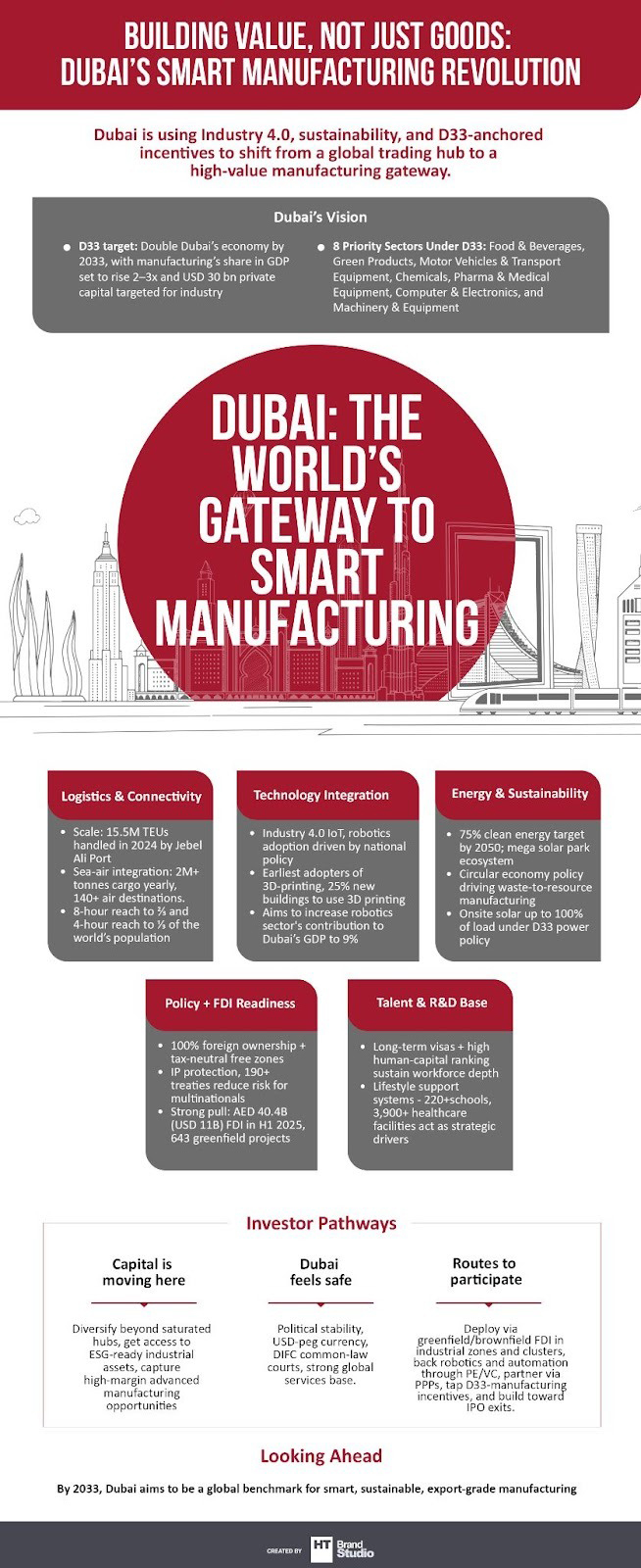
The infographic captures this shift in a simple thesis: Dubai is manufacturing the future on the back of five tightly linked enablers - policy, technology, logistics, green energy, and talent.
A vision anchored in D33 and “Make it in the Emirates”
Dubai’s smart manufacturing runway is framed by three connected strategies: the D33 Economic Agenda, a dedicated manufacturing incentives program under D33, and the federal Make it in the Emirates platform. Together, they set both the targets and the tools to reach them.
D33, launched in 2023, sets an economy-wide goal of doubling Dubai’s GDP by 2033. Manufacturing is a core lever in that expansion. The agenda targets a 2–3x rise in manufacturing GDP by 2033, adding roughly USD 16 billion in manufacturing value-added, and aims to attract around USD 30 billion of private investment into the sector.
To convert that vision into real factories, D33 concentrates support across eight priority sectors where Dubai sees durable competitive advantage - from Food & Beverages and Green Products to Chemicals, Pharma & Medical Equipment, Electronics, Machinery, Motor Vehicles, and next-gen Transportation Equipment.
The idea is clear: Dubai is not trying to be everything to everyone in manufacturing. It is picking lanes where technology intensity, sustainability alignment, and export demand travel together.
The third pillar, Make it in the Emirates is MoIAT’s national engagement and market-building campaign, linked to Operation 300bn. For Dubai, it complements D33 by adding a federal-level demand signal and engagement pathway, helping manufacturers and investors tap into SME and entrepreneurship programs to develop, manufacture, and export from the UAE.
The five enablers powering smart manufacturing
A manufacturing hub doesn’t happen by accident. Dubai’s proposition rests on an enabling stack that is already visible on the ground.
1. Logistics and connectivity.
Manufacturing competitiveness in Dubai is inseparable from its logistics edge. The Jebel Ali port complex handled 15.5 million TEUs in 2024. DXB handled 2.2 million tonnes of cargo in 2024, and the next growth cycle is anchored in Dubai World Central (DWC), with expansion plans targeting 12 million tonnes of cargo capacity, and Emirates SkyCargo connects to 140+ destinations globally.
Free zones and logistics parks sit directly inside these corridors, reducing friction from input sourcing to finished-goods exports.
2. Technology integration.
Industry 4.0 is treated as baseline, not bonus. National programs and Dubai-based future-tech platforms are pushing adoption of IoT sensors, robotics, predictive analytics, and digital twins - tools that raise throughput, reduce downtime, and improve quality.
The city’s early commitment to additive manufacturing and robotics reinforces the direction of travel.
3. Energy and sustainability.
Dubai’s industrial play is “born green.” The emirate’s clean-energy roadmap targets 75% clean power by 2050, backed by mega solar capacity and green financing platforms.
Under D33’s Industry-Friendly Power Policy, eligible manufacturers can generate up to 100% of their connected load from onsite solar, locking in low-carbon energy economics from day one.
Circular-economy policies further push waste-to-resource models, aligning factories to global ESG and carbon-border regimes.
4. Policy and FDI readiness.
Dubai pairs pro-business regulation with global investor comfort: 100% foreign ownership in most industrial activities, tax-neutral free zones, strong IP frameworks, and deep treaty networks.
The payoff shows up in capital flows: in H1 2025, Dubai attracted AED 40.4 billion (USD 11 billion) in FDI, supported by 643 greenfield projects, the highest half-year total globally.
5. Talent and R&D base.
Technology and infrastructure scale only with people. Dubai’s long-term residency pathways, high human-capital positioning, and lifestyle stack (education, healthcare, safety) help sustain a skilled industrial workforce and attract specialized global talent.
Together, these enablers form a full-stack manufacturing ecosystem - one that tries to compete on speed, sustainability, and sophistication rather than low-cost labor.
Where investors plug in
The investor logic flows directly from the industrial logic. Global manufacturing capital is being reallocated toward hubs that offer diversification away from saturated or geopolitically exposed supply chains, ESG-ready industrial assets, and higher-margin advanced production.
Dubai checks each box. It adds a de-risking layer through political stability, a USD-pegged currency, DIFC common-law courts, and a deep professional-services ecosystem that lowers operational friction.
Investors also get multiple entry routes. The ecosystem is open to greenfield and brownfield FDI in industrial zones and clusters, PE/VC participation in robotics and automation, strategic partnerships and PPPs, and manufacturing incentives backed industrial projects under D33. Over time, Dubai’s listing momentum under D33 creates a credible IPO exit pathway for investors.
Looking ahead
Dubai’s objective is not just to participate in the manufacturing reset - it is to shape it. By 2033, the emirate aims to stand as a global benchmark for smart, sustainable, export-grade manufacturing.
No VCCircle journalist was involved in the creation/production of this content.